Guide

Acoustic Glass Partition Dubai: Sound Control, Privacy and Aluminium Works Guide

An acoustic glass partition is the difference between an office that looks transparent and an office that works. Across Dubai — from Business Bay towers with permanent construction next door to open-plan floors in JVC and Sharjah business districts — tenants are specifying acoustic glass partition systems as the default for meeting rooms, boardrooms and executive offices. This guide covers five things worth knowing before you order: how acoustic partitions differ from standard glass partitions, how sound reduction and double glazing actually deliver privacy, where these systems belong, how the aluminium works side of the project (doors, windows, shopfronts, cladding and curtain walls) fits in, and how to get a site survey and quotation anywhere in the UAE. Glasser Technical Works LLC has delivered more than 500 glass and aluminium projects since 2019, with in-house aluminium fabrication Dubai clients rely on for tight fit-out programmes.

GT

Glasser Technical Works Team

UAE glass & aluminium specialists since 2019 · Updated 28 September 2026 · 9 min read

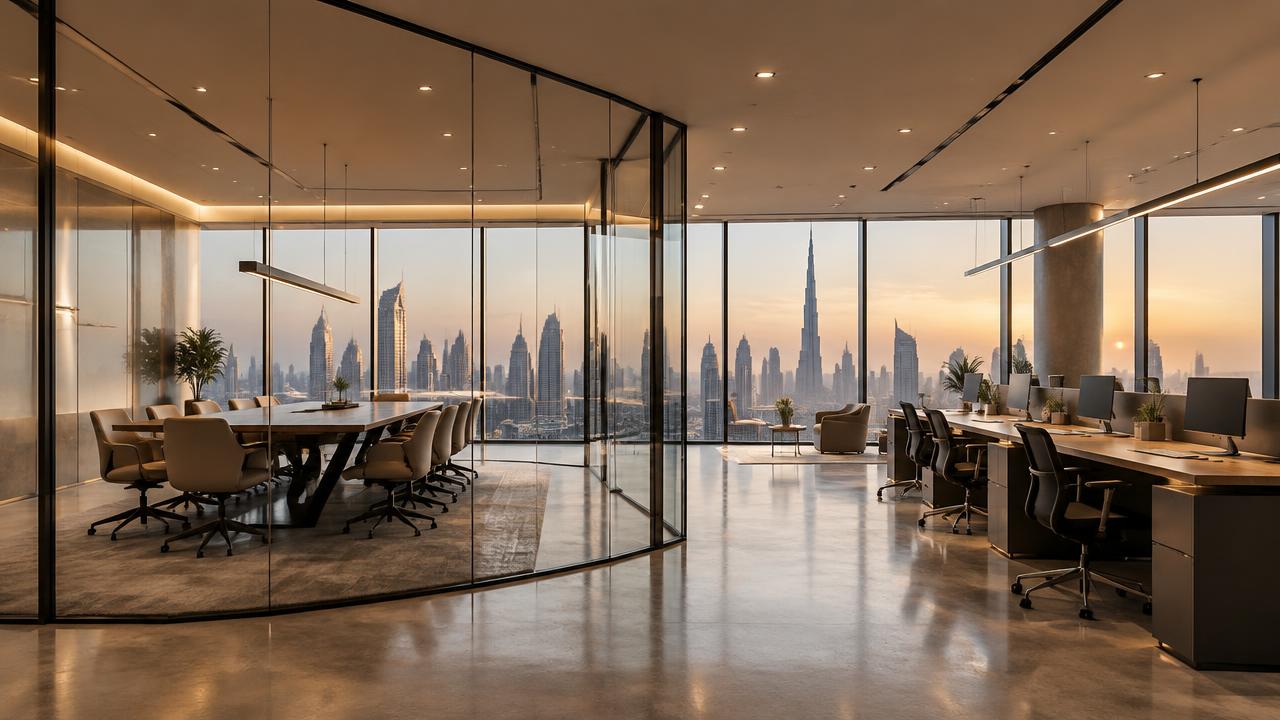
Acoustic glass partition Dubai — frameless glass boardroom with black aluminium framing in a premium Dubai office

Quick answer

An acoustic glass partition in Dubai is a full-height glazed wall built from acoustic laminated glass (single-glazed 10.8mm or double-glazed 6+16+10 build-ups) with continuously sealed aluminium or frameless detailing. Correctly installed with acoustic doors and perimeter gaskets, it cuts speech noise by 38–45 dB Rw — enough to make a boardroom genuinely private. Framed systems cost AED 750–1,250 per sqm installed; frameless systems AED 850–1,400. Pair the package with aluminium doors, windows and shopfronts from the same contractor to keep one programme, one warranty and one point of accountability.

Point 1 — Acoustic Glass Partition vs Standard Glass Partition: What Actually Changes

On the surface, the two products look identical — full-height glass walls, slim profiles, transparent rooms. The difference is inside the glass and around its edges. A standard glass partition Dubai suppliers install on budget fit-outs uses monolithic tempered glass, typically 10mm or 12mm thick. It blocks sightlines completely but only muffles sound: a single 12mm pane reduces noise by roughly 30–32 dB Rw, which means speech from an open-plan floor stays faintly intelligible inside the room. Anyone who has taken a confidential call in a standard glazed cabin and watched a colleague on the other side react to keywords knows exactly what that feels like.

An acoustic glass partition changes three things at once. First, the glass itself becomes laminated acoustic glass — two panes bonded with a specialised acoustic PVB interlayer that damps vibration in the 500 Hz–4 kHz band where speech lives. A 10.8mm acoustic laminate reaches about 40–42 dB Rw on its own. Second, the perimeter is sealed as an acoustic detail, not a decorative one: continuous EPDM gaskets at head, jamb and floor, compressible head channels against the slab, and floor channels sealed to the finished screed. Third, the doors are acoustic — solid-core leaves with drop seals rather than the standard patch-fitted swing doors that leak sound at every edge.

The practical consequence: with a standard partition, a meeting room is private only when nobody outside is trying to listen. With an acoustic glass partition installed correctly, speech from inside becomes an unintelligible murmur in the corridor at conversational volume — and in a double-glazed specification, effectively inaudible. In Dubai's 2026 fit-out market, where landlords lease open floor plates and tenants pack in more workstations than ever, acoustic partitions have moved from premium option to default expectation for any room where confidential conversations happen. For a full breakdown of the glass technology behind this, see our acoustic glass Dubai guide, which covers the physics of interlayers and dB ratings in depth.

Point 2 — How Acoustic Partitions Deliver Privacy: dB Ratings, Double Glazing, Frameless Systems and Doors

Sound reduction is measured in dB Rw (Weighted Sound Reduction Index, tested to ISO 717-1), and the scale is logarithmic — a 10 dB improvement sounds roughly half as loud to the human ear. The numbers that matter for office fit-outs: a standard 12mm monolithic partition sits near 30–32 dB Rw; a single-glazed 10.8mm acoustic laminate partition, properly sealed, reaches 38–42 dB Rw; a double-glazed acoustic build-up — for example 6.8mm acoustic laminate / 16mm cavity / 10.8mm acoustic laminate — reaches 45–50 dB Rw. For context, 40 dB Rw turns conversation into murmur; 45 dB Rw makes it disappear entirely unless someone is speaking directly against the glass.

The build-up choice is driven by the room's job, not by budget alone. Single-glazed acoustic partitions (10.8mm laminate in slim aluminium framing) are the workhorse for meeting rooms and internal offices — they hit 38–42 dB Rw at the lowest cost and keep sightlines fully open. Double-glazed acoustic partitions are the specification for boardrooms, executive offices, legal and HR rooms, and any space facing genuine noise sources — Sheikh Zayed Road frontage, plant rooms, or shared walls with neighbouring tenants. The 16mm cavity needs deeper framing, which is why the system choice must be made at drawing stage, not discovered on site.

Frameless acoustic systems deserve a specific mention because Dubai designers ask for them constantly. A frameless acoustic glass partition uses full-height panes joined with structural silicone or dry-glazed joints, with slim top and bottom channels only. The look is architectural and unobstructed, but the acoustic detailing is harder, not easier: every vertical joint must be continuous, the head channel needs a compressible acoustic gasket against the slab, and the floor channel must be sealed — not clipped — to the screed. Done correctly, frameless systems reach 38–42 dB Rw; done casually, they underperform a cheap framed system. This is why we detail every frameless glass partition with the acoustic strategy shown on the shop drawings before fabrication starts.

Doors decide the outcome. A 48 dB Rw panel wall with a standard hollow-core door performs closer to 26 dB Rw as a room, because sound follows the weakest path — the door, its frame, and the gap beneath. Acoustic doors use solid-core leaves, perimeter gaskets, automatic drop seals at the threshold and acoustic vision-panel detailing, and they are the single line item clients most often try to value-engineer out. The same logic applies above the ceiling: an acoustic partition that stops at the suspended ceiling grid leaks through the plenum unless it is taken to slab or the void is baffled. Both details are standard in our office glass partition Dubai packages, and both are cheaper to include at design stage than to retrofit after handover.

Acoustic glass partition Dubai — double-glazed boardroom with acoustic doors in a Dubai tower office

Planning a project in the UAE?

Free site survey and fixed-price quote within 24 hours.

Get Free Quote

Point 3 — Where Acoustic Glass Partitions Belong: Meeting Rooms, Boardrooms and Executive Offices

Meeting rooms are the highest-frequency application. In open-plan Dubai floors — coworking hubs in Business Bay and Al Quoz, corporate offices in DIFC and Downtown, mid-market fit-outs in Deira and Al Qusais — every booked meeting room competes with phone calls, keyboard noise and adjacent conversations. A 10.8mm single-glazed acoustic partition with sealed perimeters solves the standard case: voices become murmur, video calls stop bleeding, and the room earns its booking calendar. Phone booths and focus pods follow the same logic at a smaller footprint.

Boardrooms and executive offices justify the double-glazed step-up. These rooms host conversations with real consequences — client negotiations, legal reviews, HR discussions, investor calls — and the cost of one overheard conversation dwarfs the price difference between single and double glazing. Boardroom packages typically combine a double-glazed acoustic envelope (6+16+10 build-up), acoustic doors with drop seals, and integrated media glazing for screens. Executive offices add a second requirement: acoustic privacy without visual separation, so the corner office keeps its skyline view from Sheikh Zayed Road or Dubai Marina while remaining a genuinely quiet space.

Beyond offices, the same systems serve a wider UAE client base. Hotels use acoustic partitions between meeting and ballroom subdivisions and for suite separation. Clinics and wellness centres need confidential consultation rooms under UAE health-authority expectations for patient privacy. Law firms, financial advisors and recruitment agencies specify acoustic glass for interview rooms as a compliance matter, not a comfort one. Retail — especially high-end glass shopfront Dubai projects — pairs street-facing glazing with acoustic internal partitions for VIP consultation areas. And villas across Dubai Hills, Jumeirah and Al Barsha use acoustic partitions for home offices and majlis spaces that host guests while the household continues around them. The pattern is consistent: wherever privacy and transparency need to coexist, acoustic glass is the system that delivers both.

Point 4 — Aluminium Works in Dubai: Doors, Windows, Shopfronts, Cladding, Facades and Curtain Walls

Glass never arrives alone — every partition, shopfront and facade sits inside an aluminium system, and the quality of that aluminium works Dubai package determines how the finished project looks, seals and ages. Choosing one contractor for both glass and aluminium matters more than most clients expect: it keeps one programme, one warranty and one point of accountability across the fit-out, and it eliminates the classic coordination failure where the partition contractor and the aluminium subcontractor each assume the other owns the head detail.

Aluminium doors and windows are the residential and commercial workhorses. Sliding, swing and automatic aluminium doors serve villa entrances, office lobbies and retail access; thermally broken aluminium windows keep apartments along Sheikh Zayed Road quiet and cool. Our aluminium doors Dubai and aluminium windows Dubai pages cover specifications, finishes (mill, anodised, powder-coated RAL) and glazing options in detail. Commercial aluminium shopfronts are the retail side of the business — slim-frame, toughened-glass entrance systems for shops, restaurants, cafés and showrooms across Dubai, Sharjah and Ajman, where the shopfront is simultaneously security, climate line and the brand's first impression.

At the architectural end, aluminium fabrication covers cladding, facades and curtain walls. Aluminium composite panel (ACP) cladding is the standard envelope treatment for commercial buildings and villa extensions across the UAE — fire-rated core, hidden or exposed fastening, and fast coverage of large elevations. Aluminium facades and curtain walls are the engineered systems on towers and premium commercial buildings: stick-built or unitised grids carrying spandrel and vision glass, thermally broken, pressure-equalised, and detailed against Dubai's wind loads, thermal movement and driving rain events. Fabrication happens in-house at our Al Qusais facility — cutting, CNC machining, welding and finishing under one roof — which is what lets us hold tolerances and timelines on mixed glass-and-aluminium packages. Residential clients use the same capability for villa pergolas, glass room extensions and custom aluminium solutions built to measure, while commercial clients use it for everything from a single shopfront to full-envelope works.

Point 5 — Installation, Areas We Serve Across the UAE, and How to Get Started

A typical acoustic glass partition installation runs through five stages. First, the site survey — we measure, check slab-to-slab heights, ceiling build-ups and floor levels, and agree the dB target for each room before anything is priced. Second, shop drawings and approvals: acoustic details, door schedules and interface with MEP, submitted for client and consultant sign-off. Third, procurement and fabrication — acoustic glass units are processed by qualified UAE fabricators in 7–14 days, while aluminium profiles and acoustic door hardware are prepared in parallel at our own facility. Fourth, installation: base and head channels, glass setting, sealing, door hanging and drop-seal adjustment, typically sequenced after MEP first-fix and before flooring. Fifth, commissioning — a joint walk-through with doors closed, confirming at conversational volume that the room performs. On a standard Dubai office fit-out the acoustic partition package runs 2–4 weeks end to end.

We deliver this work across the full UAE footprint. Dubai is the core market — offices and villas in Al Qusais, Al Nahda, Deira, Business Bay, Dubai Marina, JVC, DIFC and Downtown, with location-specific guides such as glass partition Business Bay and glass partition Dubai Marina. Sharjah and Ajman projects — commercial towers, retail units and residential fit-outs — are served from the same teams, and Abu Dhabi and Ras Al Khaimah are regular project destinations for commercial and hospitality clients. Whether the project is a two-room clinic refit, a 40-cabin office floor, a hotel ballroom subdivision or a villa extension with matching aluminium windows and doors, the survey, quote and installation process is the same, and the quotation is fixed-price once the survey is complete.

Getting started is straightforward: request a site survey & quotation and we will visit, measure, agree the dB targets and system type, and issue a fixed written quote within 24 hours. If you are planning in stages, start with the rooms that carry confidential conversations — boardrooms, executive offices, HR and legal rooms — and phase standard glazed areas later; the head channels and slab details can be prepared in the first phase so later phases bolt on cleanly. For cost benchmarks before the survey, our office glass partition cost Dubai guide sets out realistic 2026 AED pricing by system type. Glasser Technical Works LLC — a licensed Dubai glass and aluminium contractor operating from Al Qusais since 2019 — handles the glass, the aluminium, the doors and the seals as one package, so the acoustic performance you approve on paper is the performance you get in the room.

Frequently asked questions

How much does an acoustic glass partition cost in Dubai?+

Framed acoustic glass partitions in Dubai typically cost AED 750–1,250 per square metre supplied and installed, including aluminium framing, acoustic gaskets and standard hardware. Frameless acoustic systems run AED 850–1,400 per sqm. Acoustic doors are priced per leaf, usually AED 3,500–7,500. Glasser UAE provides a free site survey and a fixed written quotation.

What dB rating do I need for a Dubai boardroom?+

For confidential meetings, target 38–42 dB Rw between the room and the open floor — enough that conversation becomes an unintelligible murmur outside. Client-facing boardrooms and executive offices on busy floors benefit from 45+ dB Rw, which requires double-glazed acoustic build-ups and acoustic doors.

Can acoustic glass partitions be frameless?+

Yes. Frameless acoustic partitions use full-height tempered acoustic laminated glass with silicone or dry-glazed joints and compressible head gaskets. Correctly detailed, they reach 38–42 dB Rw — the acoustic performance depends on continuous perimeter sealing, not on having a visible frame.

Do acoustic partitions need special doors?+

Yes. Sound follows the weakest path, so a 45 dB Rw glass panel paired with a hollow-core timber door performs closer to 26 dB Rw overall. Acoustic doors use solid-core leaves, drop seals, acoustic frames and gasketed edges — they are non-negotiable when rated privacy matters.

Do you provide aluminium works together with glass partitions?+

Yes. Glasser Technical Works LLC is both a glass partition contractor and an aluminium contractor in Dubai — aluminium doors, windows, shopfronts, cladding, facades and curtain walls are fabricated in-house at our Al Qusais facility, so glass and aluminium packages are coordinated under one contract.

Which areas do you serve?+

We install acoustic glass partitions and complete aluminium works across Dubai, Abu Dhabi, Sharjah, Ajman and Ras Al Khaimah — in offices, villas, retail shops, restaurants, hotels and showrooms. Site surveys anywhere in the UAE are free of charge.

Request a Site Survey & Quotation

Free site survey across Dubai, Abu Dhabi, Sharjah, Ajman and Ras Al Khaimah — fixed-price quote within 24 hours.

Request a quote